Editorial Postscript, No. 76 — For Me, “the Sword” Is Synonymous with “the Heart”
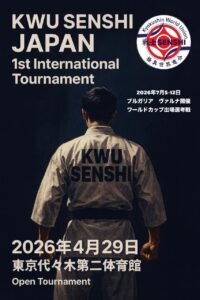
Thanks to the support we received, we were able to successfully conclude the KWU SENSHI JAPAN Karate Kanto Open on November 3.
This event had been in planning for a year, but we were unable to finalize our direction, and preparations did not progress as hoped until the middle of this year.
In addition, on the final day of the youth training camp in August, I tore the rectus femoris muscle in my left leg—a first-time experience for me.
The doctor told me that I must first use crutches, warning that otherwise the recovery would be delayed.
However, I could not afford to rest; this event was scheduled to take place just three months later.
To make matters worse, the venue I had reserved a year earlier had been canceled due to a clerical error.
Ordinarily, this would have meant that everything was lost.
I did search for an alternative venue, but none could be found.
When I consulted Aoki-sensei, he told me, “If it’s in Sagamihara, we can manage somehow,” and secured an alternative location.
To be honest, it was inconveniently located and quite small, but there was no choice.
I regarded all responsibility for this situation as my own.
I wavered between “Should I give up?” and “Should I go ahead?”
However, I anticipated that canceling now would make next year’s major event even more difficult.
It may be an inappropriate analogy, but next year marks the “start of battle.”
Yet, there were no warriors ready to fight, and the chain of command had yet to be established.
The “battle next year” I refer to is not one in which we imagine an enemy, fight, and win.
The battle I envision must be “the beginning of a story in which we raise the banner of our ideals and fight for a noble cause.”
I hesitated.
I had to rely on a body that could barely walk and on a body that grows increasingly frail with each passing year.
I questioned myself: “Can I really do this? Do I have the strength and resolve?”
On the other hand, regardless of my anxiety and restlessness, those around me said, “Let’s do it.”
I thought, “What? We’re really doing this? … Truly?”
And I felt, “They don’t quite understand the situation.”
Yet I reconsidered: “I should trust those around me and give everything I can. This too is part of my training.”
And so, I did it. In the end, everyone around me worked tremendously hard.
Looking back 30 years, I founded a small karate organization with longtime friends and hosted about twelve All-Japan tournaments.
On the final day of the first tournament, I even passed blood in my urine.
I also stayed up many nights without sleep due to stress.
To be honest, running those tournaments was more grueling than karate training itself.
As a result, several important comrades left my side.
Now, I feel only gratitude toward them.
Compared with those tournaments, this recent one was small in scale.
However, being a perfectionist, I tend to chase the ideal endlessly.
As a result, I burden those around me and drive my own body and mind to their limits.
Even so, although this tournament was small, I was able to join forces with two trusted companions—Akiyoshi and Aoki—who are like my right and left arms.
I want to engrave this experience deeply in my heart as something irreplaceable, and to carry it into the next chapter of our story.
On the day of the event, we were unable to finish the preparations for the emcee script, and I felt a knot of pain in my stomach over that failure.
At that moment, I remembered Mr. Hirao, the longest-standing member of my dojo.
Thirty years ago, he volunteered to prepare the emcee script and managed the event’s proceedings.
At the time, he worked in the personnel department of a major department store.
As those memories resurfaced, a renewed sense of gratitude toward him welled up within me.
Mr. Hirao is now suffering from ALS and is bedridden.
A few months ago, he asked several of the senior black belts who had known him for decades to “come and see him.”
I went immediately.
Although he could no longer speak, his wife conveyed his message:
“My husband says he cannot die yet, and that he will keep fighting.”
Another person I have known for over forty years, Ogino-sensei, was diagnosed with Parkinson’s disease several years ago.
Even so, when I told him that we were short of referees and asked if he could help “even just a little,” he served as the chief referee for an entire day.
Receiving that expression of commitment from Ogino-sensei, I now feel that I cannot abandon my ideals or aspirations—not until the very end.
The truth is, Mr. Ogino and I are like family.
Seven years ago, he was also diagnosed with cancer, but—fortunately and miraculously—he recovered.
From time to time, I travel with him.
That said, it is usually only that he accompanies me on work trips or during my training in the sword.
These days, I find joy in training with the sword.
Yet because my body is so damaged that I cannot even sit in seiza, I cannot train in any rigorous way.
I sometimes think that had I trained seriously before my body broke down, I might have advanced further.
But now, I am not practicing swordsmanship at that level of aspiration.
The “joy” I feel is not related to improving my ability to cut or becoming more skillful technically.
Rather, even as my body ages and deteriorates, I can perceive the martial arts from a dimension different from my youth.
I now feel joy in challenging a new horizon—another form of “limit”—distinct from the physical limits I glimpsed in my prime during the one-hundred-man kumite.
To put it boldly, the “sword” as I conceive it is synonymous with “the mind.”
To refine the mind through the sword.
To refine the mind through the martial techniques of fist and foot.
To refine the mind through birth, aging, illness, and death.
All are one and the same.
And this is what I call “training.”
I wish to continue enjoying this training for the rest of my life.
Five-Line Poem
For me, “the sword” is synonymous with “the mind.”
Through the sword, the mind
Through the martial skills of fist and foot, the mind
Through birth, aging, illness, and death, the mind
All things, at last, become one
(Shinichi – “One Mind”)